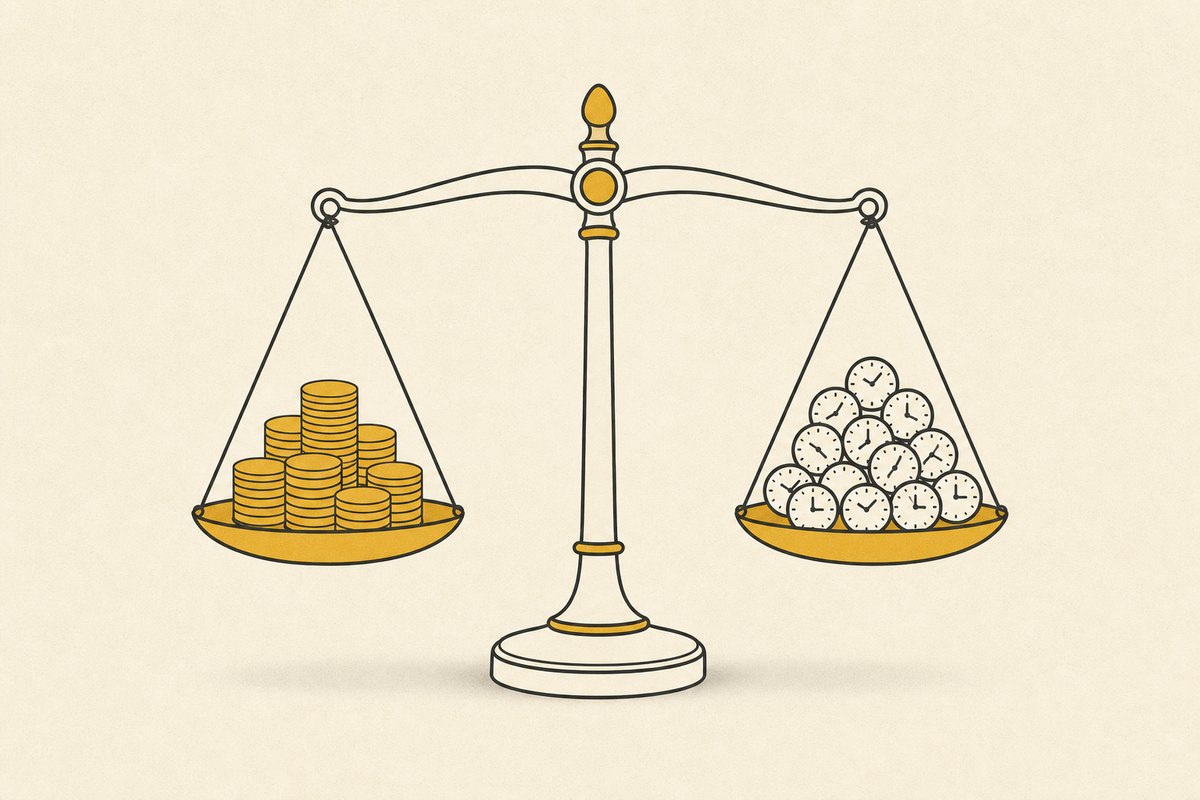
A provider who cannot put figures on what they propose is asking you to take their word for it. Yet the calculation is not complicated. It fits on one line:
Time saved × loaded hourly cost + errors avoided + additional revenue − total cost of the solution.
All the value of the calculation lies in how each term is filled in. That is where optimistic estimates give themselves away.
Time saved
It is measured beforehand, in the field, not by guesswork. Two classic mistakes: counting the task alone without the switching time between tools, and forgetting that the automation creates its own human time, that of validation and correction. The right figure is net time: time before, minus time after, supervision included.
One consequence is often misunderstood. Automating a twenty hour per week task and a thirty minute per week task are not even comparable: the second will never pay back its development, however elegant it is.
The loaded hourly cost
Not the gross salary: the full cost to the company, charges included. And the cost of the right person: when an automation frees up time from a director or an expert, the calculation changes order of magnitude entirely.
An honest caveat: freed time is not saved money until that time is reassigned to something productive, or until it avoids a hire. That is a question worth asking bluntly before validating a figure.
Errors avoided
This term is often the largest, and almost always forgotten. A wrong invoice, an order sent twice, a follow up never sent, a lost quote, a non compliant file: these events have a real cost that the company knows, but that it attaches to no process. Costing it means counting frequency over the last twelve months and the average unit cost.
Additional revenue
The most fragile term, and therefore the one to handle with the greatest caution. Replying in ten minutes instead of two days raises the conversion rate: that is measurable, provided it is measured before and after, over the same period of the year. Until it is measured, this term stays at zero in our calculations. A growth projection is not a gain.
Total cost, the one that gets underestimated
- Build. Development, integration, tests.
- Consumption. Model calls, per use, which rise with volume.
- Supervision. The human time spent validating and correcting, every month.
- Maintenance. Changes in connected tools and in business rules, which happen whether you want them or not.
- Internal time. Your teams' time during the project, which is a real cost even if it appears on no invoice.
A calculation that only includes the first line is a wrong calculation. That is why we always talk about annual cost, never about an entry price.
What we do with it
We apply this calculation to every process on the list drawn up during the mapping phase, then we rank them. Some lines rise, others fall, and we say so: a good share of the automation ideas circulating in a company will never pay back their cost. Knowing that before building is part of the work.
Our digital maturity audit produces exactly that costed ranking. Sometimes it concludes that nothing should be launched this quarter. That is a result, not a failure.