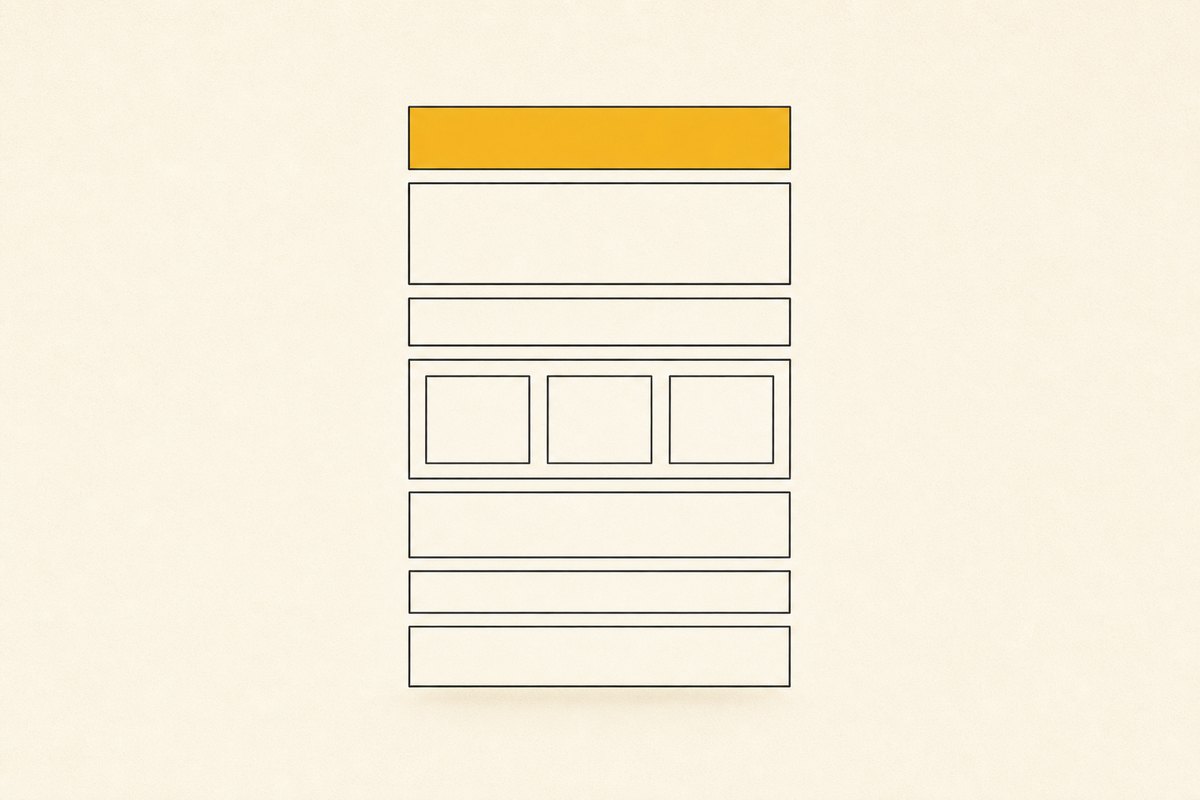
A page that converts isn't a well-decorated page. It's a page whose order matches the questions the visitor asks themselves. Changing that order means answering before anyone has asked, or answering too late.
1. What it is, in one sentence
Visitors should understand within five seconds what you offer and who it's for. A headline that doesn't name the service fails at this step, and everything that follows becomes pointless.
2. The problem, in their own words
Before talking about the solution, the person needs to recognize themselves. A precise description of the problem creates a sense of accuracy, “they understand my situation,” that buys you attention for what follows.
Until visitors have recognized themselves, your solution is talking to an empty room.
3. How it works
Three or four concrete steps, with timeframes. This block removes the fear of the unknown: what's expected of me, what you do, and when. It's often the missing section, and one of the most decisive.
4. The proof
- Projects with a result, not just an image.
- Specific, dated reviews, which work better than an overall rating.
- Verifiable elements: years in business, volume, certifications, guarantees.
5. The price, or at least a ballpark
Hiding the price completely drives away serious visitors and attracts those with no budget. If you can't give a fixed rate, a range or a starting point is enough to let people self-select: it's a service to both sides.
6. Objections, addressed head-on
Lead times, commitment, what happens if something goes wrong, what isn't included. A page that answers the awkward objections gains credibility; a page that dodges them leaves visitors to resolve them alone, and they resolve them against you.
7. The action, repeated without nagging
One type of action per page, offered at three moments: after the initial promise, after the proof, and at the end. Multiplying different actions (call, sign up, download, request a quote) dilutes the decision instead of making it easier.
Check your seven blocks
Take your main page and check that these seven blocks are there, in this order. Most often, two are missing: “how it works” and the explicit handling of objections. Adding them changes your results more than a change of colors will.
A page doesn't convince because it's beautiful. It convinces because it answers in the right order.