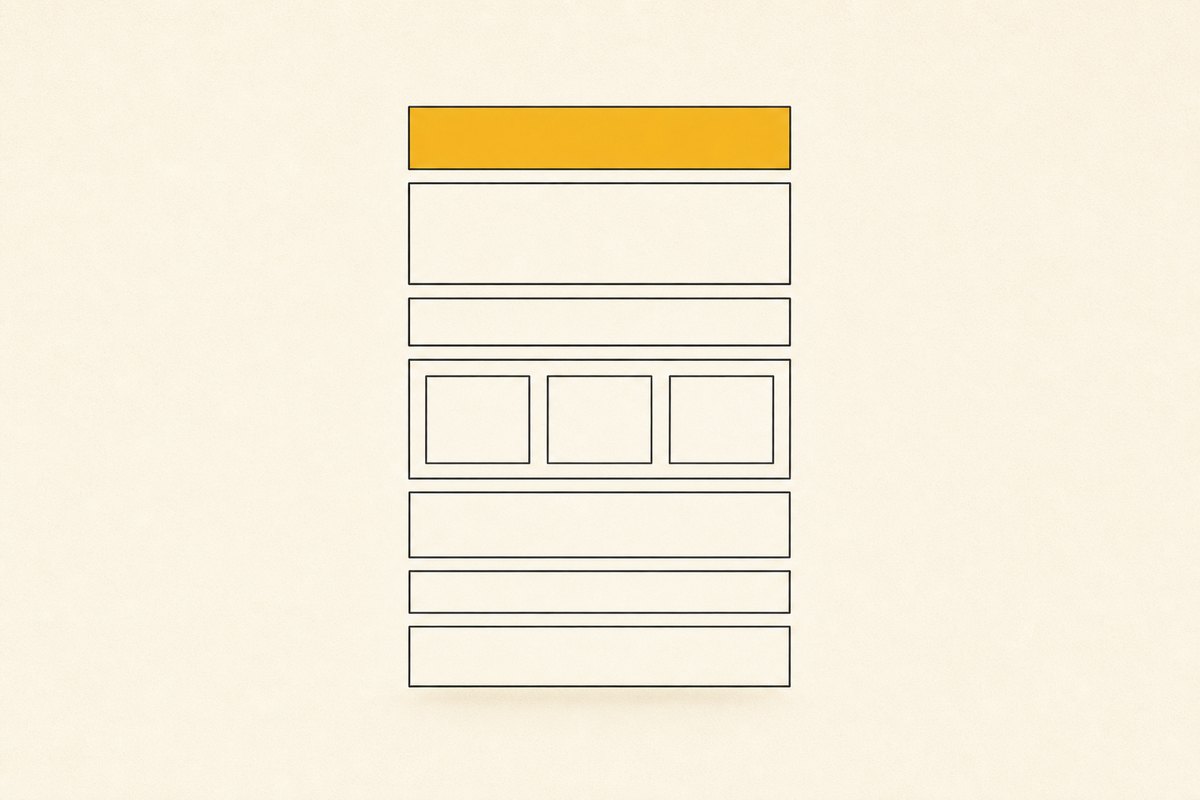
Custom design has a flattering reputation: unique, tailored, professional. It also has a cost that few businesses examine closely. That cost doesn't come from the final styling, but from the time spent re-deciding what has already been decided everywhere else: where to put the navigation, how to structure an offer page, when to ask for contact.
What is truly specific to your business
Your offer, your proof, your photos, your words, your contact journey. This is where differentiation lives, and it's precisely the part that gets handled last, with whatever budget is left, once the time spent on structure has run out.
A visitor doesn't notice your layout grid. They notice that they don't understand what you do.
What isn't
- The placement of the menu and the contact button: conventions exist because they work.
- The order of sections on an offer page: problem, solution, proof, price, action.
- Behavior on mobile: the question is settled, and reinventing it mostly produces regressions.
- The technical foundations: speed, structure, accessibility, markup.
Rebuilding these elements from scratch means paying to arrive, with a bit of luck, at the state of the art that already exists.
When custom is truly justified
When your customer journey is unusual: a configurator, complex appointment booking, a customer portal, a catalog with its own logic. When your brand is a major asset and its visual singularity is part of what you sell. When you need to connect to existing systems. In these cases, the investment can be defended point by point.
For a showcase site meant to explain an offer and trigger a contact, it's much harder to defend.
The deciding factor: time
A custom site takes weeks of back and forth. In the meantime, the old site keeps failing to convert. A proven template, dressed with your content, puts a solid version online quickly, which you then improve with real data rather than assumptions.
It's a reversal of method: instead of deciding everything upfront, you launch fast and adjust based on what you observe. It's almost always more effective, and cheaper.
What is really specific to you
List what, in your project, is genuinely specific to your business. If the list fits in three lines, your offers, your proof, your contact journey, custom design will mostly make you pay for rebuilding existing conventions.
Pay for what sets you apart. Not for rediscovering what everyone already knows.