Since 19 June 2026, a business that sells to consumers through an online interface must provide a function allowing them to exercise their right of withdrawal, free of charge, from the website or app. The principle appears in article L. 221-21 of the code de la consommation (French Consumer Code), and the detailed rules in article D. 221-5.
The right of withdrawal itself does not change: fourteen days, counted from receipt of the goods, or from the conclusion of the contract for a service. What changes is the path. Customers no longer have to hunt for a form or write to customer service: they must be able to withdraw online, right where they bought.
Who is affected
Contracts concluded at a distance between a business and a consumer through an online interface, whether they involve selling goods or providing a service. An online shop, a site for booking services, or a subscription taken out in an app all fall within the scope.
The Code excludes certain contracts from this regime, including financial services, which have their own rules, package travel, and passenger transport. The existing exceptions to the right of withdrawal still apply: goods made to the customer's specifications, for example, still do not carry this right. No right of withdrawal, no function to display.
Contracts concluded before 19 June 2026 remain subject to the previous rules.
What the text requires, precisely
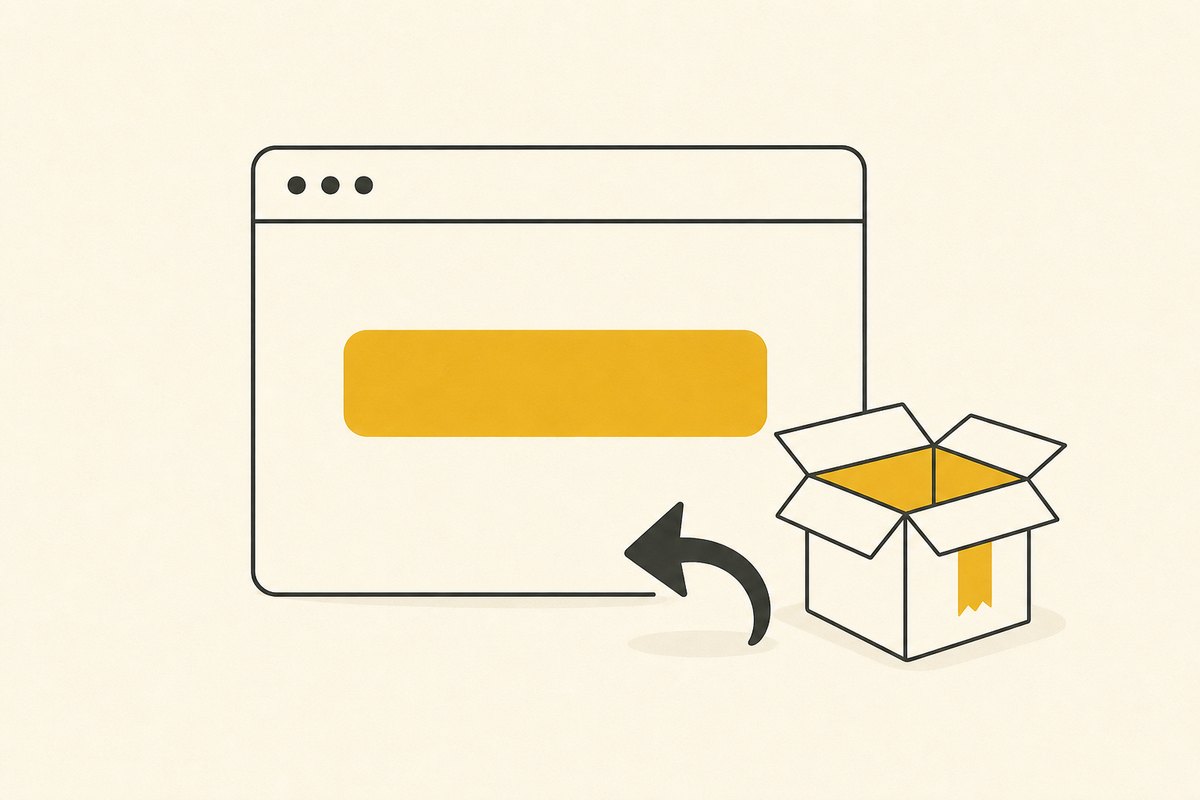
Clear wording. The function is identified, legibly, by the words “renoncer au contrat ici” (“withdraw from the contract here”) or an equivalent, unambiguous phrase.
Visible, permanent access. It is displayed prominently, directly and easily accessible, and available throughout the withdrawal period.
A simple statement. It lets the customer submit a withdrawal statement online, making it easy to enter their name, the details identifying the contract, and the electronic means by which they will receive the acknowledgement of receipt.
A confirmation. Submission is validated by a button identified by the words “confirmer la rétractation” (“confirm withdrawal”) or an equivalent phrase.
An acknowledgement of receipt. The business sends it within a reasonable time, on paper or another durable medium, an email for instance.
There is also an information obligation: before the contract is concluded, the consumer must be told, where applicable, that this function exists and where to find it (article L. 221-5).
A function tucked away at the bottom of a customer account, behind a forgotten password, sits poorly with “direct and easy” access. That is the first point to look at.
What non-compliance costs
Breaches of the articles governing the exercise of the right of withdrawal, including article L. 221-21, are punishable by an administrative fine of up to €15,000 for an individual and €75,000 for a legal entity (article L. 242-13). Failing to provide the pre-contractual information carries a fine of the same amount (article L. 242-10).
A useful reminder along the way: when the information on the right of withdrawal has not been provided to the consumer, the withdrawal period is extended by twelve months from the end of the initial period (article L. 221-20).
Four checks to run on your site
Look for the function like a customer. Start from the order confirmation email, then from the home page: how many clicks does it take to find it? If you hesitate, so will a customer.
Test without an account. Many shops accept guest checkout but reserve returns for the customer account. That is precisely the journey to check.
Send a test statement. See what lands in the inbox, and how long it takes. An acknowledgement that never goes out because the sending tool is misconfigured is a purely technical flaw, and a very common one.
Reread your information pages. Your terms and conditions of sale and the information shown before ordering must now say where the function is located.
The right reflex
The text does not ask you to make withdrawal attractive, it asks you to stop making it difficult. Treated as a journey in its own right and tracked in your order system, it becomes data: how many withdrawals, on which products, and when. It is often the most instructive way to read a catalogue.
Sources: articles L. 221-5, L. 221-18, L. 221-20, L. 221-21, L. 242-10, L. 242-13 and D. 221-5 of the code de la consommation (French Consumer Code), as worded following ordonnance n° 2026-2 and décret n° 2026-3 of 5 January 2026, consulted on Légifrance on 15 September 2026.