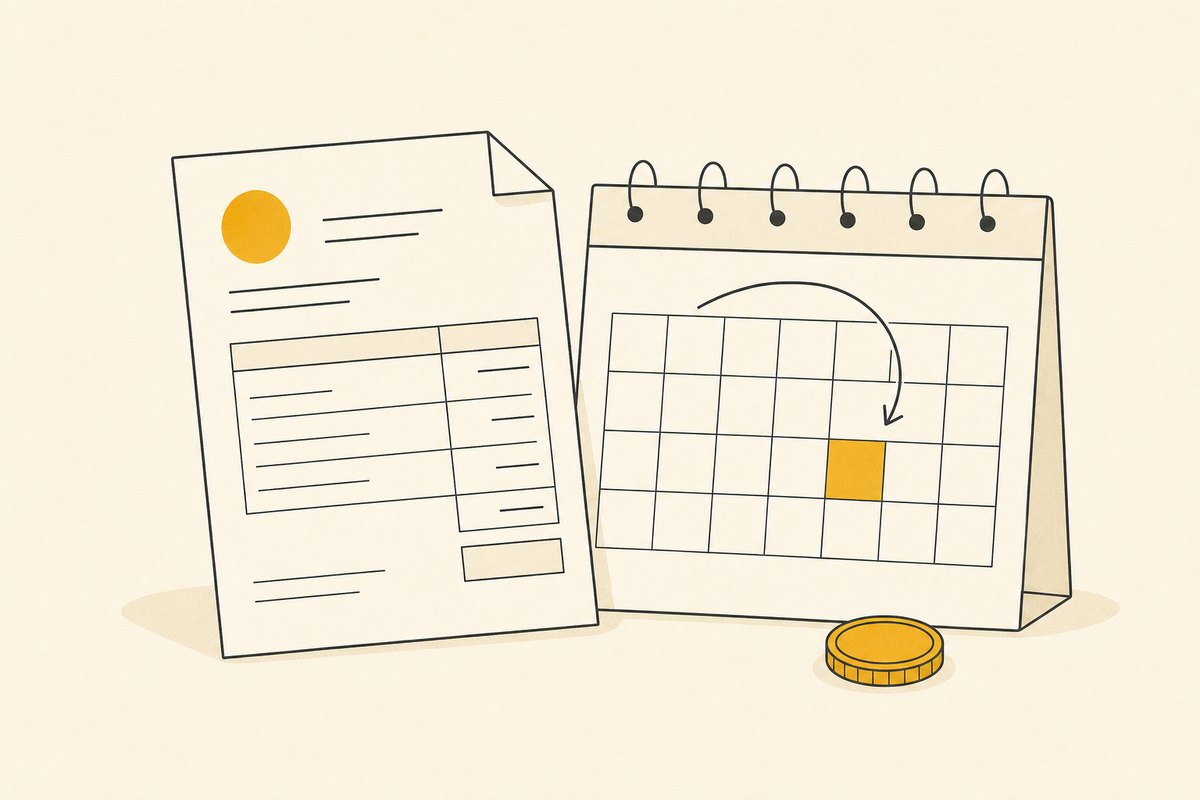
Between two businesses, the agreed payment term cannot exceed sixty days after the invoice issue date. The rule is set out in Article L441-10 of the code de commerce (French Commercial Code). It applies to a craftsperson invoicing a company just as it does to a shop paying a supplier, and it comes with an administrative fine.
The payment terms the law allows
Article L441-10 distinguishes four situations. With no agreed term, payment cannot be due more than thirty days after the goods are received or the service is performed. With an agreed term, it cannot exceed sixty days after the invoice is issued.
One exception exists: forty-five days end of month after the invoice is issued, on two conditions. It must be expressly stated in the contract, and it must not be a manifest abuse against the creditor. For recurring invoices, the agreed term cannot exceed forty-five days after issue.
Late-payment penalties and the €40 fee
Section II of the same article requires the payment terms to state the rate and conditions for late-payment penalties, which become payable the day after the payment date shown on the invoice. The rate cannot be lower than three times the statutory interest rate. If nothing is specified, it equals the rate of the European Central Bank's most recent refinancing operation, plus 10 points.
These penalties are due without any reminder being needed. On top of them comes a fixed fee for recovery costs, owed automatically by any business that pays late: Article D441-5 sets it at €40. If your actual costs are higher, you can claim additional compensation, with supporting evidence. The creditor cannot claim it when insolvency proceedings prevent the debtor from paying on the due date.
What you risk if you don't follow these rules
Article L441-16 provides for an administrative fine for four types of breach: failing to respect payment terms, leaving out the required mentions from the payment terms, late-payment penalties whose rate or conditions are non-compliant, and failing to respect the methods for calculating terms agreed between the parties.
The ceilings are €75,000 for an individual and €2,000,000 for a legal entity. They rise to €150,000 and €4,000,000 for a repeat offense within two years of the date on which the first penalty decision became final. These are ceilings, not set rates.
Four checks to run in your own business
Do your payment terms state the penalty rate? Leaving it out is one of the penalized breaches, just like a rate below three times the statutory rate.
Is your payment term in writing, and does it stay within the limit? Sixty days after the invoice is issued, or forty-five days end of month if the contract expressly provides for it.
Do you claim the €40 fee? It is owed automatically, yet many small businesses never ask for it.
Are your own suppliers paid on time? The rule works both ways: a business owner is a debtor before being a creditor.
What could change
A bill titled "Lutter contre les défaillances d'entreprises" (fighting business failures) was adopted by the Senate at first reading on 19 February 2026. As of the date of this article, it has not come into force. Among other things, it would start the payment terms from receipt of the invoice rather than its issue, from 1 January 2030. We will update this article if it is enacted.
Responsibility for compliance remains with the business: this article is for information and does not replace a lawyer's advice on a specific situation.
Source: articles L441-10, L441-16 and D441-5 of the code de commerce, consulted on Légifrance on 20 October 2026; text adopted by the Senate on 19 February 2026 (senat.fr, consulted on 20 October 2026).